


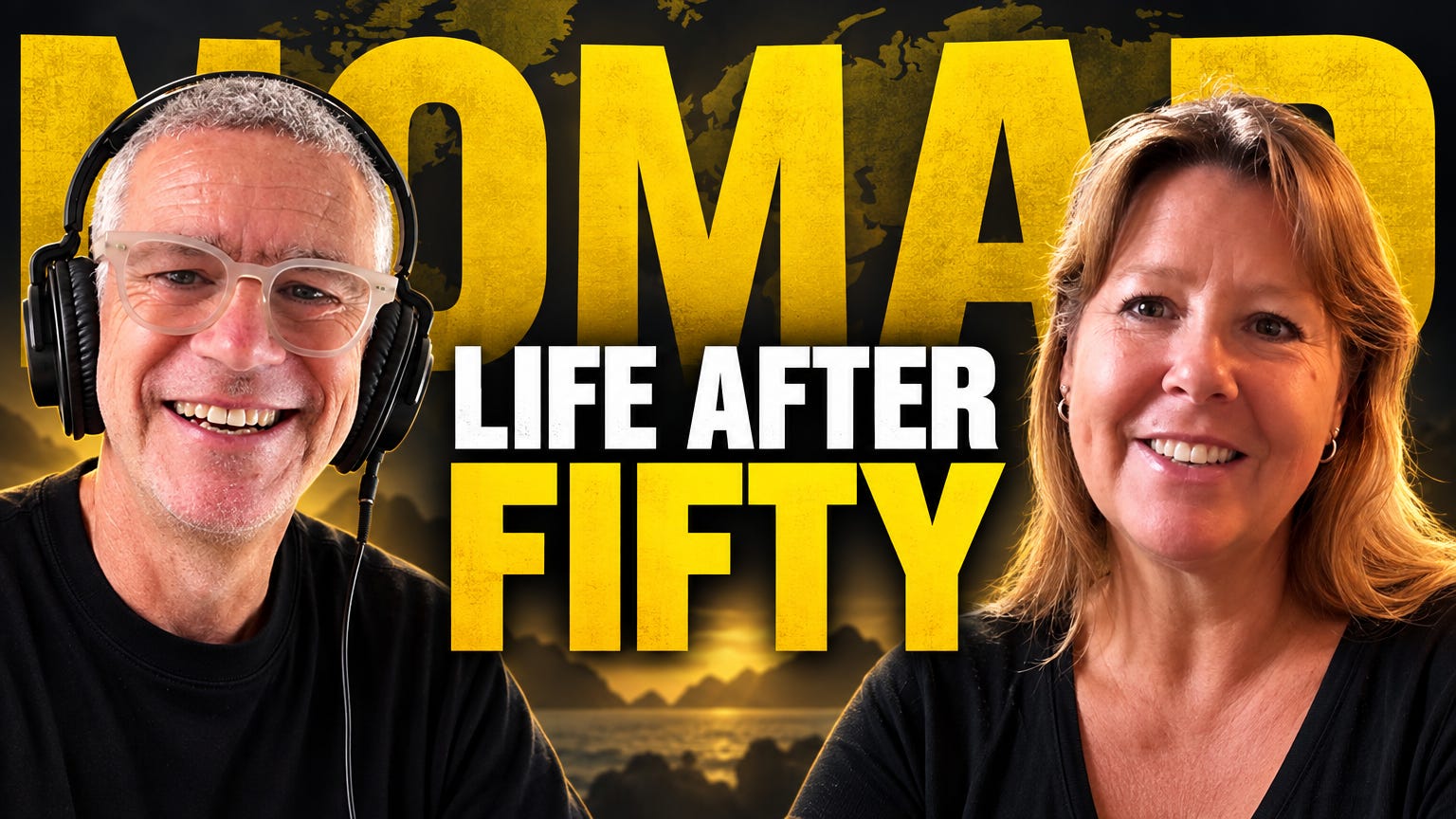
I found Jo Barnes the way you find most good people these days: through Substack comments. She writes The 50+Nomad newsletter, we kept turning up on each other’s posts, and eventually I asked her onto the podcast.
Here’s the short version. Jo has been building businesses online since 2010. She raised her daughter in Phuket, Thailand. Now she and her husband are nomadic, and she recorded our chat from a hotel room in Chiang Mai.
But this isn’t a story about quitting your job and flying to Bali. It’s about staying curious, getting uncomfortable on purpose, and building something you actually enjoy. Which, as regular readers will know, is very much our territory.
A low boredom threshold and a bigger comfort zone
When I asked what makes Jo able to do this, she didn’t hesitate. “I think I’ve got a really low boredom threshold.” She wants things happening, and she’d rather get that buzz from experience than anything else. Her husband needs a closed door and no noise to work. Jo heads for a coffee shop or co-working space, because she wants the hum of people around her, even strangers.
She always wanted to travel more. When they set off in 2010 the plan was to be more nomadic than they ended up being, but they had a four-year-old who needed stability. So they settled in Phuket for about twelve years, and Jo escaped for three or four weeks a year with her sister. When her daughter graduated last year, Jo was ready to put on the backpack on again.
Her husband was less sold. He prefers a routine and a base. So 2027 will probably mean a home base in the UK, some travel together, and some solo trips for Jo.
This year alone: London in early February, Rio Carnival with her sister, up the coast of Brazil, three days in the Amazon, Colombia, the US West Coast, the Canadian Rockies, then down the US East Coast. The year before, seven or eight months in Brisbane while her daughter worked a gap year before London.
Does all that make her more resilient? Jo said yes and no. Thailand is very safe, and after twelve years she’d slipped into an expat comfort zone, even with the yearly trips. South America last year made her nervous. What she found was this: “boots on the ground will always tell you what’s actually happening in a place.” Be sensible, she said, but don’t take your safety briefing from headlines.
The Instagram version vs the real one
I asked her about the “$10K a month in Bali” fantasy. Her answer: “the reality is it’s bloody hard work.” She still works on beaches, under an umbrella, laptop on her knees, and it’s as good as it sounds. But it’s work.
She sees two roads.
• Freelancing is the fastest. Jo’s point is that people over fifty carry decades of experience, then talk themselves out of selling it because they think nobody wants an older hire. She reckons that experience makes for better pitches than a lot of the youngsters manage.
• Building your own thing (a Substack, e-commerce, digital products, content) takes longer. Her estimate is 12 to 18 months, maybe two years, before something is sustainably off the ground.
The flip side is that it has never been easier to start. Jo remembers spending four hours working out how to put a PayPal buy button on a web page, and crying in an apartment in Cyprus over a video embed. These days, she said, you just tell Claude to embed the video.
Selling scratch-off cards from a hotel room
Jo’s main project now is This Big World, a travel brand. The first product is This Big Travel Challenge: 50 scratch-off cards you take on a trip or a weekend away. Scratch one off and do the challenge. Deliberately take a wrong turn and see where you end up. Hunt down the weirdest souvenir in a tourist shop, then hand it to the first person who makes you smile. Right now, heading into Christmas, they’re selling like hotcakes.
This isn’t her first run at e-commerce. In 2016 she and her husband built a kitchen products business on Amazon and sold it in 2020. She doesn’t cook, so this time she wanted a niche she loved. The inspiration was an Australian stationery brand with beautiful journals and cards, but aimed at travellers. The plan is to grow into cards for couples and solo adventurers, bucket list cards and travel journals.
How does that work from the road?
Jo wrote the challenges and hired a designer for the cards.
She found suppliers in China to do the scratch-off and printing, and had samples sent to her while she was in Australia.
Stock goes to Amazon warehouses, and Fulfilment by Amazon does the shipping.
Her main goal is Shopify, because there she owns the customer. On Amazon, Amazon does. Orders from her Shopify store can still be fulfilled by Amazon.
The catch is that she can only fulfil in the US for now. Local distribution partners come later as the brand grows. She was upfront that e-commerce is one of the harder businesses to run as a nomad, because there are a lot of moving parts.
Start small, stay relevant, build a community
Jo isn’t fussy about labels. Digital nomad, whatever. For her it’s the freedom to live and work from anywhere, whether that’s a kitchen table or a beach in Fiji. And she’s a big believer in building online projects as we get older, to keep us sharp and give us a reason to get out of bed.
They don’t have to be big. Her example is her sister, a keen gardener. Start a Substack about gardening, grow to 100 people paying $10 a month, and that’s $1,000 a month for writing about something you love. Other routes she mentioned: freelancing, Kindle books, blogging and SEO, YouTube, and paid communities.
On relevance, Jo and I landed in a similar place. Women feel invisible as they age, men feel they’ve gone from being the person in the room to a person in the room. Her take: “I think we need to create our own relevance.” And invisibility has its perks, because you can get on with it without anyone watching.
I added my own two cents. A good life needs agency (nobody can tell you no) and a sense of accomplishment, and work tends to hog the second one. Jo added purpose. She likes the Japanese idea of ikigai, and what stands out for her is community and having something to wake up for. Loneliness, she said, is an epidemic.
Community is also where AI can’t help, and I think that makes it a moat. Jo agreed, with a warning. Most people are bad at building communities because they set up a group and walk away. Her line: “Groups do not start self managing until you’ve reached the tens of thousands.” She’s even thinking of building a community for e-commerce people herself.
Pick one thing (and forget marketing)
Here’s the bit Jo wants everyone to hear. This year she was half in on the cards, half in on Substack, half travelling and half writing a book. “That’s four halves,” she said, and it doesn’t add up. For the last three months she’s put almost everything else on the back burner to focus on the cards, and sales have grown fast. Her advice for overthinkers with lots of hobbies: pick one for the next year, then layer the others on top. She quoted Seth Godin: “the shortcut is usually the longest route.”
Then I confessed my own problem. I come from broadcasting, I love writing, video and storytelling, and I find social media marketing a slog. Jo loves it, so she’s an unfair judge, but she had a plan for me.
Forget marketing. Drop the word, and drop the social networks that come and go in five seconds.
Embrace YouTube, which she described as “more of a search engine than a social network.”
Keep Substack as the hub. Publish the video to YouTube, and put the audio on Spotify and Apple through the RSS feed.
Learn YouTube SEO. Work out what people in your niche are searching for, then answer those questions in your titles, thumbnails and interviews.
Do only that for the next 12 to 18 months.
She’s not worried about marketing. She’s worried about solving the problems people are actually searching for, and then showing up where they search.
Find Jo
• Travel challenge cards: thisbigworld.co, or go straight to the product page at thisbigworld.co/gift.
• Her Substack:The 50+ Plus Nomad.
If you have a travel lover in your life and no idea what to buy them, you know where to go.
If you’ve been sitting on an idea for years, the free One-Page Small Bet is a one-page way to start. Three steps, and a date inside 48 hours.
Want to go further? The Small Bet Kit below takes the same idea through five short lessons, with a coach to talk it through.
Stop planning the big leap. Make a small bet.
Most of the people I’ve interviewed on the podcast didn’t reinvent themselves in one dramatic move. They started a small thing on the side, and one day they looked up and it had become their actual job. That’s a small bet, and I’ve built a kit to help you make one. It’s five short lessons, a worksheet, and a coach you can talk to that asks the awkward questions and shrinks your idea until it’s embarrassingly small. Two weeks, one real first move, no quitting your job required.
It’s US$15. No hustle, no 5am alarms, and nobody telling you to bet the house.
[Get the Small Bet Kit] → https://generalistalan.eden.so/small-bet-kit
Paid subscriber? It’s already yours, so skip the button. Sign in at generalistalan.eden.so/sign-in with the email you use for Substack.


