


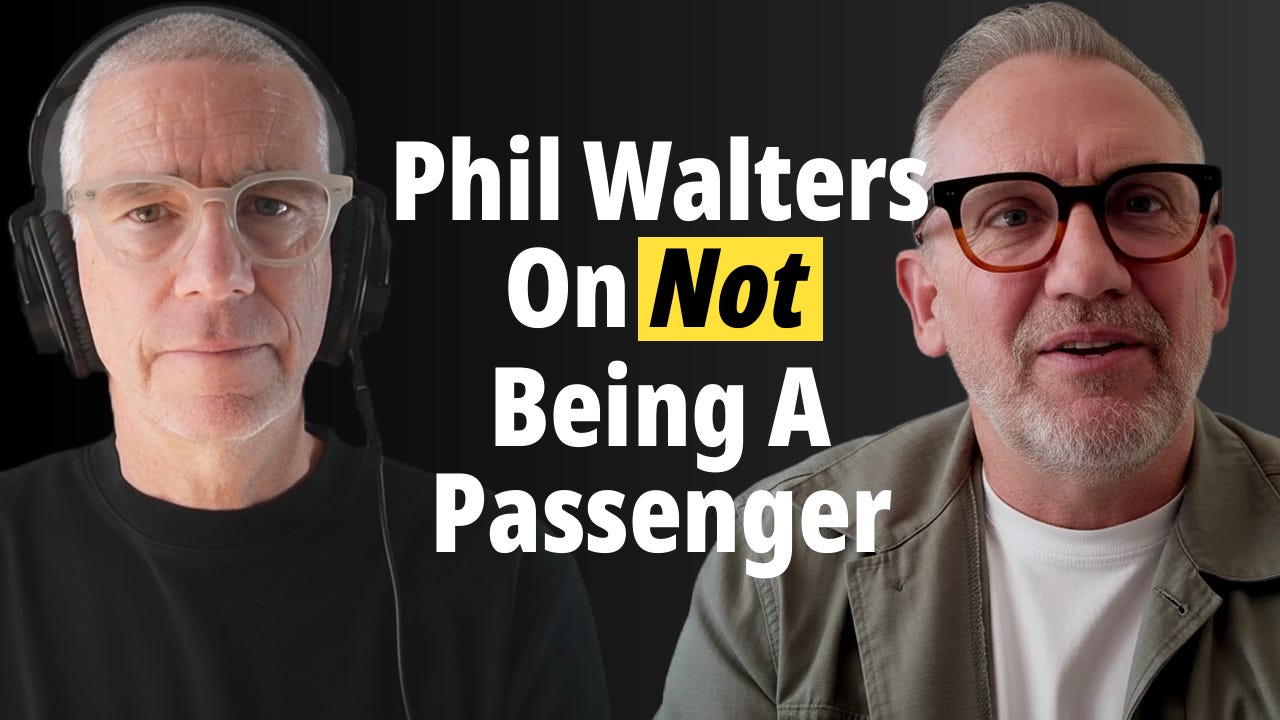
I’ve known Phil Walters for years. If you live in New Zealand and haven’t noticed one of his steel birds hammered into a tree or a fence post somewhere, you just haven’t looked up. Phil started cutting them in his backyard shed in Ponsonby in 2009, nailing them into lamp posts and power poles around the neighbourhood to amuse his kids and the locals.
Fifteen years later, Metal Bird has sold over two million birds across nine countries. Their best year was $35 million in online sales in the US alone. There are nine warehouses around the world and a call centre in the Philippines.
When we sat down to record, I expected to spend most of our time on scaling and marketing, the mechanics of building something from a shed into a global operation. And we did. But the part that stayed with me came about three-quarters of the way through.
I asked Phil what he thought was actually stopping people from taking the kinds of risks he’d taken.
“I think it’s risk aversion. And I think that’s a really important thing to know about yourself.”
He talked about a Venn diagram he’s drawn for his kids over the years. Three circles: what can you do, what do you love to do, and where’s the money. The goal is to land in the middle.
The thing that moved him wasn’t a book or a business insight or a conversation with a mentor. It was losing his wife.
She died in 2012, from lymphoma. She’d been the one who sparked the whole creative direction in the first place. A prolific photographer, always exhibiting. Phil had felt the pressure to make something of his own. She was initially sceptical Metal Bird would go anywhere.
Phil didn’t dwell on it. But what he said was one of the most honest things I’ve heard anyone say in one of these conversations.
“When you watch somebody just fade away... with it totally beyond her control. If you’re not that person, it just makes you go: I’m not being a passenger in my own life.”
“I’m not being a passenger in my own life.”
He said something else that’s been rattling around since. In his studio, there’s an unofficial motto: “We’re not going to die not knowing.” When a new idea comes up, when something feels uncertain, the answer isn’t to wait for more clarity. It’s to have a crack.
He also said something about failure I’d never quite heard framed this way. Failure isn’t binary. You don’t win or lose. You don’t go on or off. Success and failure are, in his words, “sweaty bedfellows.” One can’t exist without the other. You don’t really understand what success feels like until you’ve genuinely felt failure, and vice versa. It took him, he reckoned, about 59 years to fully believe that.
“Failure is a continuum, not binary. You don’t either win or lose. They’re sweaty bedfellows.”
He also has a phrase he gives to design students when he talks about getting started: FIIDI. Fuck it, I’m doing it. The point isn’t recklessness. It’s removing the imaginary catastrophe from the equation. Because the actual worst case, most of the time, is that you try something, it doesn’t work, and you find out something genuinely useful.
What I keep thinking about is this: most of us wait for conditions to improve before doing the thing. More certainty, more capital, more confidence, more runway. Phil’s point, gently made, is that the conditions don’t shift on their own. What changes is you. And sometimes what changes you is the thing you’d never have chosen.
That’s not a comfortable idea. But it’s an honest one.
Try this
Write down the thing you’ve been putting off. Then write down the actual worst case if it doesn’t work. Not the vague dread. The specific, concrete thing. What would you actually do? How would you actually recover?
Most people find the risk they’ve been carrying is smaller than it felt. And the risk of doing nothing, of just staying exactly where you are, is bigger than they’d counted.
Phil Walters is the founder of Metal Bird. You can find them putting native birds back into trees, one fence post at a time, in nine countries.


