


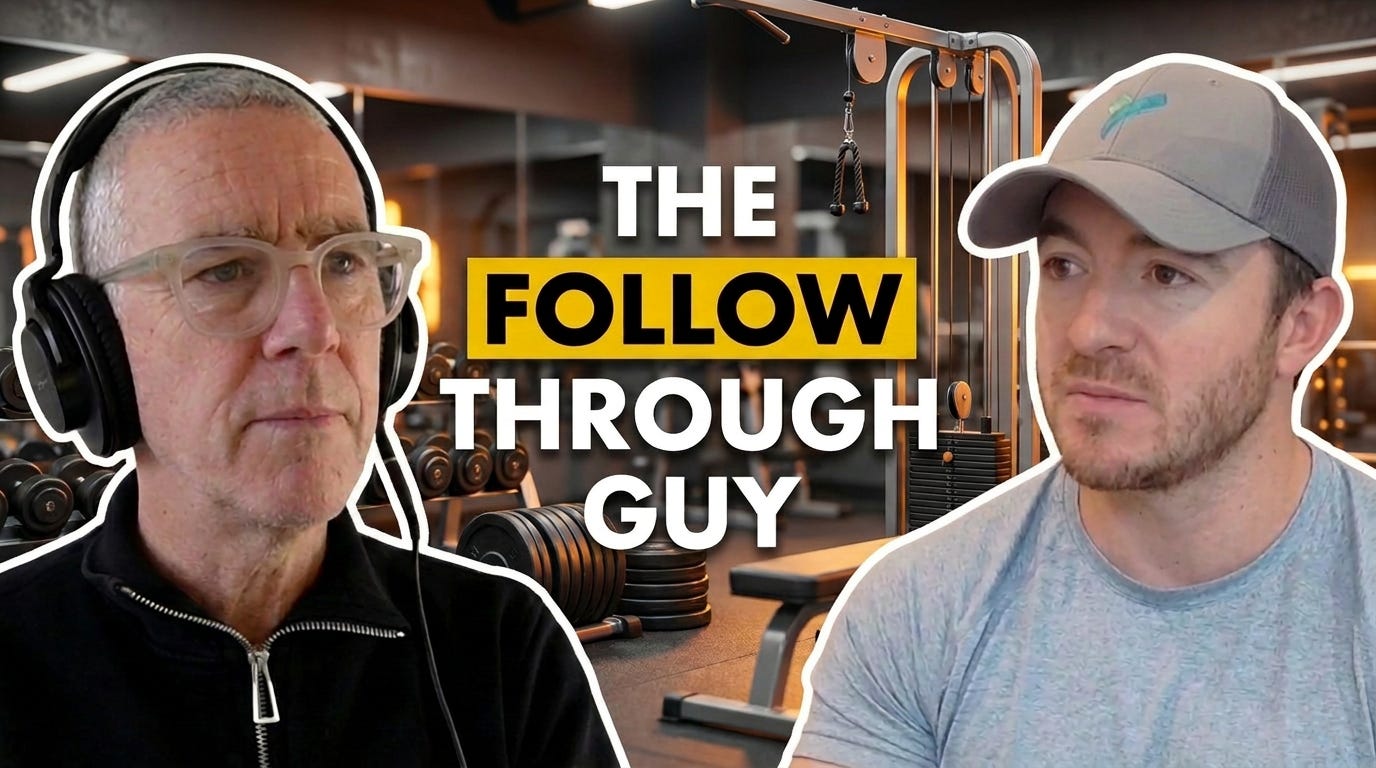
That tells you something. MyBodyTutor got me out of an office chair and, eventually, through an Ironman, back when Adam was just a voice in the inbox. I’ve followed the business ever since. So getting him on the podcast felt less like an interview and more like finally meeting a mate who’d changed my life from the other side of the world.
The Day-One Exit Plan
Adam started his career at Ernst & Young, one of the big four accounting firms. The dream job on paper. His mum was thrilled. And from the first day, he knew it was wrong.
The pull came from somewhere harder. He watched his father’s health collapse through his childhood: a heart attack in seventh grade, triple bypass days later, then multiple sclerosis and a long decline until he died. That was the making of Adam’s obsession with health and fitness, and he became the go-to guy handing colleagues a plan.
They always loved the plan. And there was always a but. “I love the plan you made for me, but I got caught up with work, life, kids.” The follow-through was the hard part. Adam had found his business hiding inside everyone else’s excuses.
He quit in January 2007. His mum thought he’d lost his mind, told him people would kill to be in his shoes. He started MyBodyTutor the following month and hasn’t stopped since.
A mission is something you have to do no matter what.
The distinction stuck with me. An opportunity is something you chase because it looks good. A mission is something you’d be doing anyway. “I will outlast anyone,” he told me, “because I’d be doing this no matter what.” That’s not a growth hack. It’s a reason to still be standing nineteen years later.
The Broccoli Problem
Here’s where Adam’s story gets useful for the rest of us, whatever we’re trying to change.
He’s not in the information business. Never has been. Everyone knows broccoli is good for them. Nobody ends up in hospital with a protein deficiency. The knowledge is free and everywhere, and it changes almost nothing.
Across ten thousand-odd clients, what Adam has learned is that success is mostly what’s going on between your ears. Food is a coping mechanism. The long-term rational part of you wants the goal, the short-term irrational part wants to sit down and eat, and they’re at war most days. His real job is helping people get out of their own way.
The standout thing he said was this: he can’t help someone solve a problem until they work out why they like having it. Every behaviour has a motivation. Telling yourself you’re too busy is reinforcing something. Being overweight can be a security blanket, and once the weight is gone the question becomes, well, now what. Get to the root and the plan finally has somewhere to land.
The Cost of Standing Still
I asked him the big one. Why don’t people change? No hesitation. Fear.
His definition of self-sabotage is simple: fearing the very thing you say you want. A business owner who wants to serve more people but believes growth means less freedom will keep a foot on the accelerator and the brake at once, forever. A few good days, then nothing. Until you reconcile that contradiction, you’ll keep undoing your own work.
And the thing we all forget is that doing nothing is not the safe option. Adam cleaned out his garage recently and found boxes that had sat untouched for six years. If he hadn’t, they’d sit there another six. “The cost of inaction is massive,” he said, “and it does not get talked about often enough.” Look at how your typical week goes, then ask whether you want twenty more years of exactly that.
The more we seek comfort, the faster we’re going to age.
He’s a big believer in self-imposed discomfort, the small hard things you choose, because they train you for the hard things you don’t. Doing something new only feels bad because it’s new. What’s easy now was once hard. Discomfort, he reckons, is a compass. It tells you you’re heading somewhere different, which is usually the right direction.
Small Is the New Big
For anyone standing at the edge of a change, this was the most reassuring bit.
Adam stayed at Ernst & Young two years longer than he wanted to, not because he lacked the nerve but because he thought he had to build the next Google. The bigness of the idea made it impossible. Then it clicked. He didn’t need to build an empire. He needed to coach one person. MyBodyTutor started with three clients.
Start small. And if that feels too big, ask what’s the least you can do without doing nothing. Treat it as an experiment or a project rather than Your New Career, and you give yourself permission to have the ups and downs.
He’s wary of the expectations social media loads onto all of us, not just the kids. The fitness “experts” who do nothing but train and film themselves all day. The business types renting the Lamborghini. Audit your feed, he says, because your feed becomes your thoughts, your standards, your idea of normal.
What AI Can’t Do
I put the obvious worry to him. Couldn’t someone build an app that does what he does? Wake you up, count your calories, tick the box?
He didn’t flinch. AI makes knowledge more available, which is fine, because knowledge was never the problem. His whole business is the gap between knowing and doing. The test he offered was perfect: would you feel bad letting AI down? Of course not. The accountability that works is human to human, someone who spots your patterns, names the limiting belief, and would actually be disappointed in you.
Same with the GLP-1 drugs. A tool, and a genuinely useful one for some, but it handles hunger, not habits. Nothing beats changing your relationship with food.
What I Took From Our Chat
The thread through all of it, the pivot, the coaching, the nineteen years, comes down to follow-through. And follow-through is a deeply human thing. Adam built a business on the least glamorous truth in self-improvement: knowing what to do was never the issue.
The thing he said that stayed with me is about what this has done for him. At Ernst & Young he’d get a stomachache on the walk to work. Now, besides being a dad, this is the great joy of his life. “Every day that I’m not at Ernst & Young is an amazing day.” Nineteen years in, and he still means it.
A few things worth stealing
Chase a mission, not an opportunity. Pick the thing you’d still be doing if it never paid off, and you’ll outlast everyone chasing the shiny version.
Find out why you like the problem. Every stuck behaviour is serving you somehow. Before you fix the habit, work out what it’s protecting you from. That’s usually the actual work.
Count the cost of standing still. Inaction feels safe and isn’t. If nothing changes, your next twenty years look like your last week. Let that scare you into moving.
Let discomfort be the compass. New things feel bad because they’re new, not because they’re wrong. What’s easy now was once hard. The uncomfortable direction is often the right one.
Start embarrassingly small. You don’t need to be the next Google. Adam started with three clients. Ask what’s the least you can do without doing nothing, call it an experiment, and begin.
Fifteen years since I first signed up, I’m still glad I did. Turns out the guy who taught me to follow through built an entire life by doing exactly that.


