


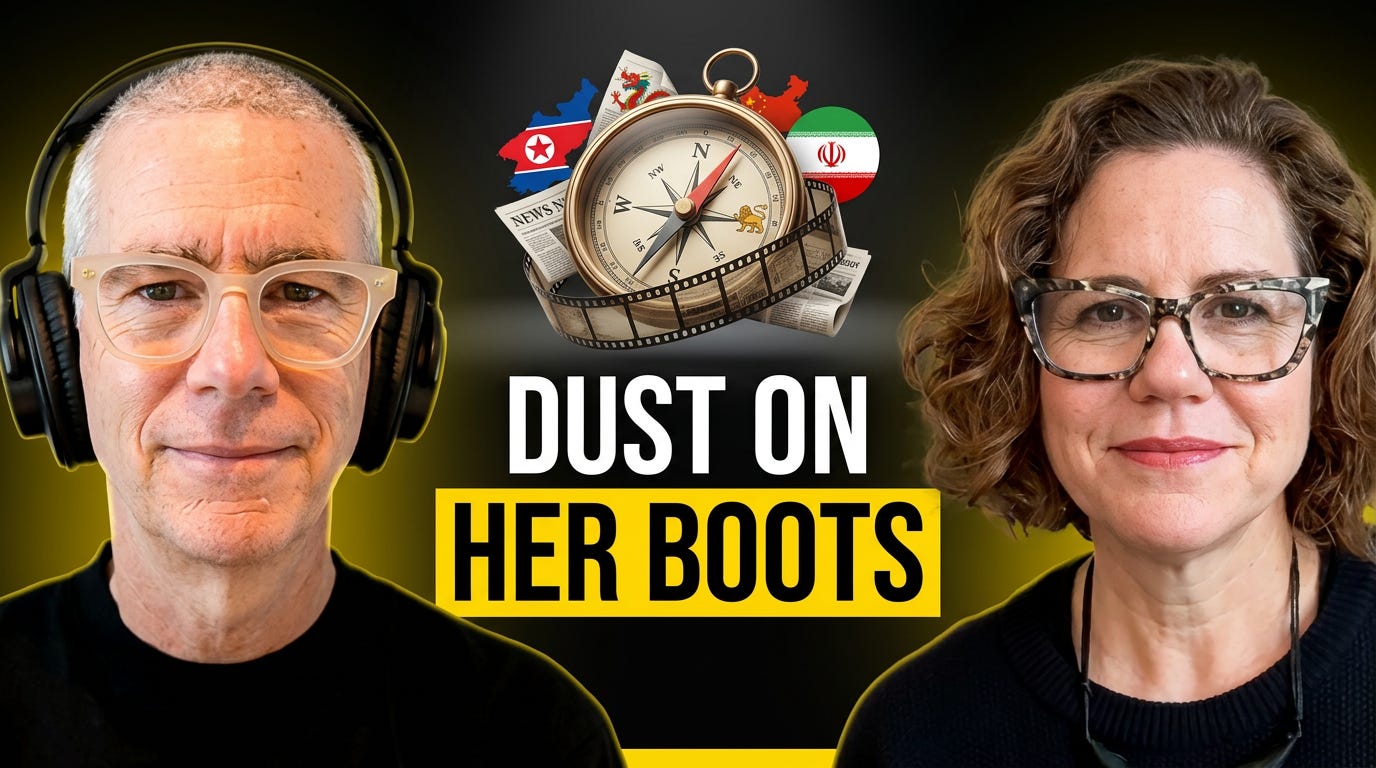
Anna Fifield got made redundant in February. She turned fifty in March.
“It felt like the universe was telling me something,” she told me. Most people, handed that combination, go looking for the next salary. Anna thought about it, looked at other jobs, even wondered whether it was time to leave journalism. Then she did something far more interesting.
The Hastings kid who wanted the world
Anna grew up in Hastings, watching Cameron Bennett and Liam Jeory from Television New Zealand race around the Balkans on the news and deciding that was the job. Foreign correspondent. Far-flung places, real people, hard questions. She went to journalism school in Canterbury, started at the Whakatāne branch office of the Rotorua Daily Post, and won a three-month fellowship to the UK. A journalist she’d met once or twice, Rod Oram, made an introduction to the Financial Times.
She stayed thirteen years. Economics correspondent. Postings to Seoul, Tehran and Beirut. White House correspondent through the Obama years. Then Harvard, then the Washington Post, where she ran the Tokyo and Beijing bureaus and finished up as Asia editor. Somewhere in there she went to North Korea twelve times and wrote the book on Kim Jong-un. By anyone’s measure, a dream run.
Dust on boots
The reporting she loved most she calls “dust on boots.” Not the Washington briefing room (”not enough dust), but the ground itself. China, Iran, the edges of North Korea. Ordinary people under extraordinary regimes.
“These are ordinary people trying to do their best under a terrible system.”
That, she argues, is what we lose when foreign desks shut. Not the satellite imagery of China’s militarisation, which still gets done, but the texture of life in the places we’d rather caricature. The detention camps in Xinjiang. The North Koreans who’ve all seen the K-dramas and quietly know the whole thing is a lie. You only get that with someone on the ground.
The bloodbath
In February, the Washington Post closed almost its entire foreign desk. Anna was one of around 374 journalists who lost their jobs in what she calls the bloodbath. The book section went. The sports section went. The daily news podcast went.
She’s blunt about the bigger picture. Billionaires are buying up American media, and the old custodianship, the vanity project that bought a rich man a bit of mana, has curdled into something more pointed.
“They are no longer benign owners. They are ones with political motivations.”
She sees flickers of the same risk closer to home, in the way some New Zealand politicians talk about TVNZ and RNZ. Her warning is simple. Editorial independence is not something we can take for granted.
Between Giants
So here’s the leap. Rather than chase another masthead, Anna launched a Substack. It’s called Between Giants, and you can guess who the giants are. Spurred on by Bernard Hickey, the OG of New Zealand Substackery, she set out to bring decades of foreign reporting back home, through a New Zealand lens.
Three months in, she has three and a half thousand subscribers. There’s no paywall, yet nearly ten percent of them choose to pay anyway. People stop her in the street. She files a column for the Listener, a world bulletin for the Spinoff, and went to the Shangri-La Dialogue in Singapore, where she lobbed a pointed question at US defence secretary Pete Hegseth about who, exactly, counts as a freeloader. It made waves back in New Zealand.
She’s given herself a year. She’s working twice as hard, answering to no one, and, in her own words, having a blast.
“This is a moment in my life and in the world, and I’m going to give myself a year and see if I can make it work.”
A few things worth stealing
Redundancy and a milestone birthday are not a verdict. Anna read hers as a starting gun, not a full stop. The crunch point is only a crunch point until you decide what it’s for.
Your back catalogue is the business. She didn’t start from zero. She took thirty years of contacts and judgment and pointed them somewhere new. Whatever you’ve been doing, that’s your roller deck. Use it.
You don’t have to wait for permission. No masthead handed Anna an audience. She built her own, one piece at a time, and the hunger was already there.
Free can still pay. No paywall, and one reader in ten pays anyway, because they value the work. Generosity and a living aren’t mutually exclusive.
Anna spent a career explaining other people’s countries to the rest of us. Now she’s explaining the world to her own. The masthead’s gone. The reporter, it turns out, was the thing worth keeping all along.
You can find Anna here Between Giants


