


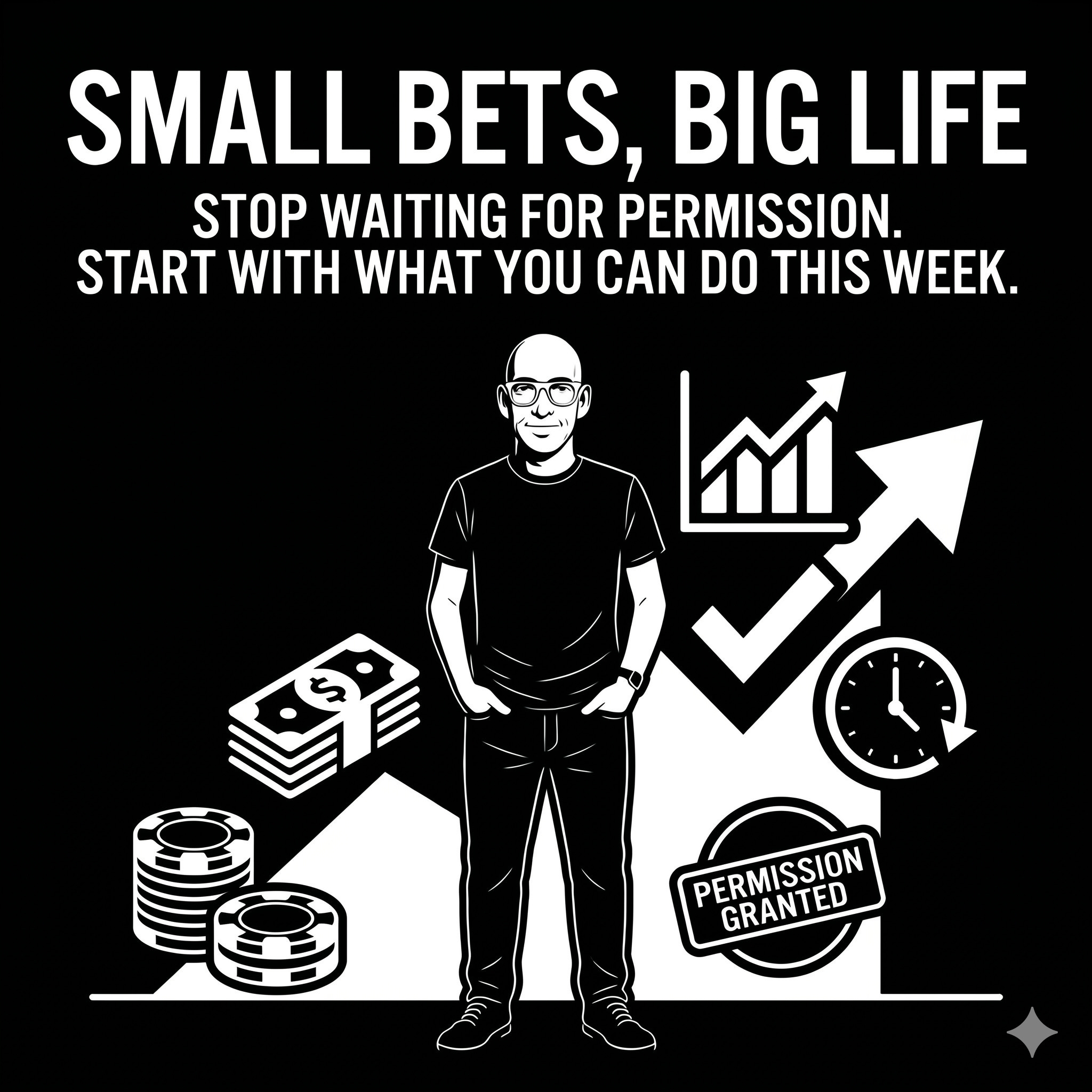
You know the story. Someone quits their job, sells their house, moves to Bali, and launches a seven-figure business. It’s the narrative we’re sold. It’s also bollocks.
The honest version of every story sounds far less cinematic. It usually goes something like: “I just started doing this small thing on the side, and then one day I looked up and it had become my actual job.” No drama. Just a series of quiet experiments that eventually pointed somewhere worth going.
This is what a small bet actually is.
Why We Get This Wrong
We’re obsessed with the dramatic pivot. The decisive moment. The all-in bet that changes everything. It feels like the only way to justify a career change, especially if you’re midway through one that’s already paid for your mortgage and your kids’ school fees.
So we wait. We plan. We tell ourselves we’ll make the leap when the conditions are perfect, when we’ve saved enough, when the market is right, when we’ve got permission from someone who matters. And we never do.
The pivot wasn’t a leap. It was a series of small, low-stakes bets that compounded quietly until the evidence was impossible to ignore.
“The pivot wasn’t a leap. It was a series of small, low-stakes bets that compounded quietly until the evidence was impossible to ignore.”
What a Small Bet Actually Looks Like
A small bet isn’t a hobby. It’s a genuine test of a hypothesis about your future. It’s offering a single workshop. Writing one article. Recording a podcast episode. Taking on a small client. Teaching a class. Building something and putting it out there.
The point is to gather real data about a real question: does this actually work, and do I actually want to do it?
You’re not betting the house. You’re betting an afternoon. Or a weekend. Or three months of Tuesday evenings. The commitment is small enough that you can actually do it without upending your life. The risk is minimal. The information you get back is invaluable.
The Quiet Part
Here’s what makes small bets work: nobody is watching.
Nobody is watching, which means nobody is judging, which means you’re free to find out the truth rather than perform a version of yourself you’ve decided to become. You can fail quietly. You can learn without an audience. You can discover what you actually want instead of what you think you should want.
The Math
If a small bet works, you’ve got momentum. You’ve got something to build on.
And if it doesn’t work, which is entirely possible, you’ve lost very little. You’ve gained information. Which, in the business of figuring out your next chapter, is the most valuable thing there is.
Information beats certainty every time. Certainty is a myth anyway. But information? Information is actionable. It’s the difference between guessing and knowing.
Try This
Write down the thing you keep saying you’d do “if only.” Now ask yourself: what is the smallest possible version of that thing I could actually do in the next two weeks?
Not the full version. Not the ready version. The embarrassingly small, nobody-needs-to-know version.
Start there.
That’s your small bet. That’s how big lives actually get built.