


This is a slightly weird tangent. Stick with me, I’ll get there eventually.
On the weekend I went and saw The Devil Wears Prada 2 with some friends. Last week I watched a documentary called The New Yorker at 100. What struck me about both was quality and craftsmanship.
In The Devil Wears Prada 2, the quality was in the clothing, the styling, the visual display. But underneath all of that was a subtext worth paying attention to: some things are still worth obsessing over. Worth the extreme care.
In The New Yorker at 100, I saw a masterclass in production and intentionality. The New Yorker is so establishment it’s now punk rock. They understand that things need to be done well, and that is genuinely counterintuitive right now. In a world of AI, quick turnarounds and click-chasing, that kind of care stands out. People are drawn to it even when they can’t articulate why.
What the hell does this have to do with me?
This is what separates us from the machines. Not raw output. Not speed. Not volume.
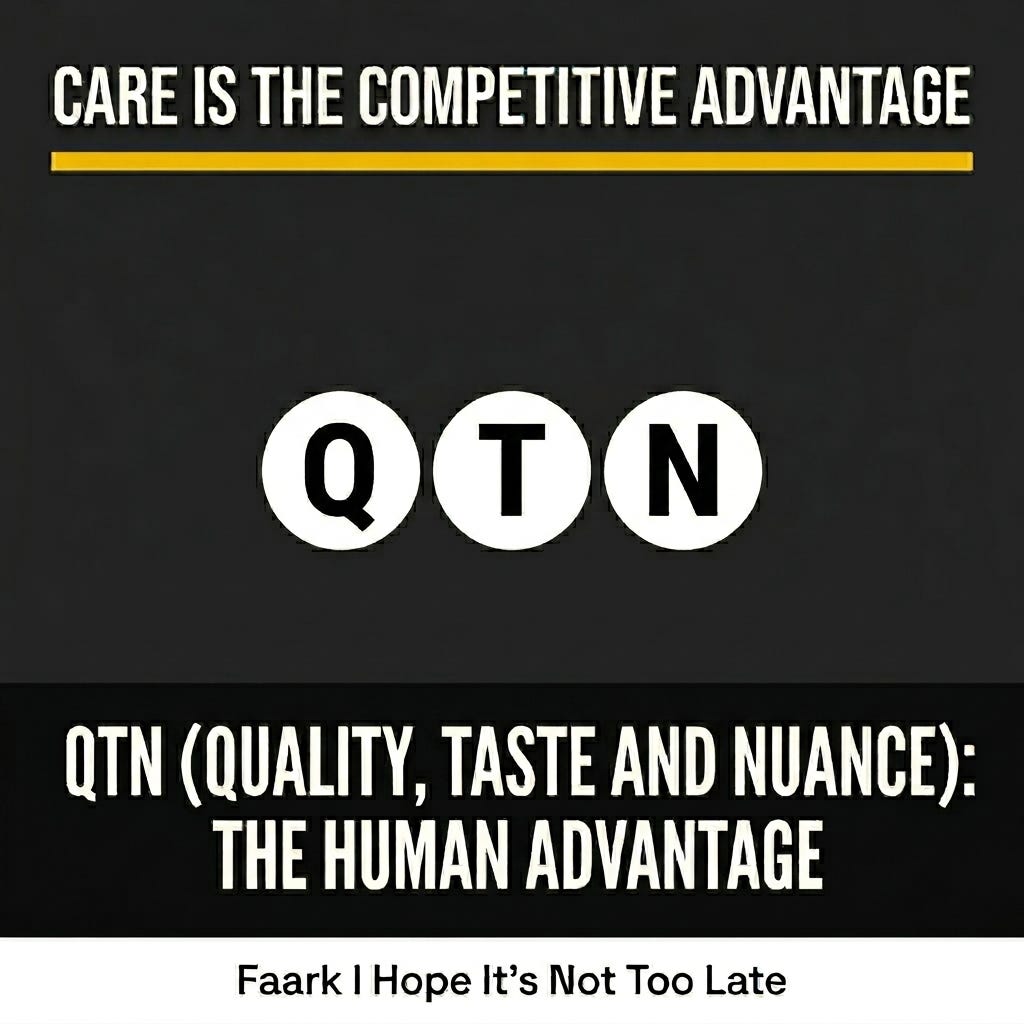
Quality, taste and nuance.
The machines can produce. They cannot obsess.
Quality
Quality is the thing you obsess over because it has to be right. Not because someone’s watching or because there’s a brief or a deadline. Because you personally cannot let it be less than it should be.
For me it’s building Faark, I Hope It’s Not Too Late. Every sentence, every episode, every piece of design. I fuss over it. I rewrite things nobody will notice. I do it because the alternative (just getting it out, done, shipped) feels like a betrayal of the whole point.
What’s your version of that? What do you return to, refine, and argue with yourself over because it genuinely matters to you?
That obsession is not a personality flaw. It’s a signal. Follow it.
Try this: Write down the last thing you spent more time on than anyone asked you to. Not because you were being paid extra. Not because anyone would notice. Just because it had to be better. That’s your quality. That’s your edge.
Taste
Taste is knowing what good looks like. It’s the curatorial instinct: the ability to look at a hundred things and say with confidence, “that one.”
You’re the person your friends ask before they watch something, buy something, or hire someone. You’ve developed a filter through years of paying attention, and it shows.
AI can process enormous amounts of content. It cannot tell you whether something is actually worth your time. That requires judgement built from experience, context, and a genuine point of view. Which is to say, it requires a human who has lived.
The New Yorker has been refining its taste for a century. That’s not something you replicate with a prompt.
Taste is built over years. It cannot be downloaded.
Nuance
Nuance is the ability to see behind the thing. To hold complexity without needing to flatten it into a take.
It’s being able to say “yes, but also...” without losing the thread. It’s the journalist who hears what’s not being said in the interview. The executive who reads the room before the room knows what it’s saying. The creative who understands that the brief is never really the brief.
AI is getting very good at summarising. It’s nowhere near as good at sitting with contradiction, reading subtext, or knowing when the obvious answer is wrong.
That’s the work only you can do.
QTN is the job now
Quality, taste and nuance aren’t soft skills. They’re not nice-to-haves. In a world flooded with generated content and automated output, they are the actual competitive advantage.
The machines can produce at scale. They can answer questions, draft copy, and churn out the functional stuff. What they cannot do is care. They cannot obsess over whether something is genuinely good. They cannot develop a real point of view from a life lived. They cannot see behind the surface of things.
You can. Most people won’t bother.
The question isn’t whether AI is going to eat into the work. Some of it, it will. The real question is what’s left when it does. And what’s left is the work that requires a human who gives a damn.
That’s a pretty good place to be.
The brief that is never really the brief…yes!